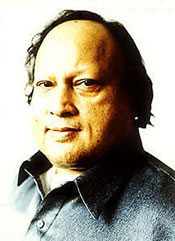
The world of awards always falls too short in front of a great man of stature of Nusrat Fateh Ali Khan. No award can exceed the Unimaginable Enduring love and respect poured by millions of fans and thousands of artists around the globe on Nusrat Fateh Ali Khan. Once a magazine wrote " Nusrat’s voice has conquered more Alexander’s sword". World knows that the statement was true. However for the very simple and humble Nusrat, the greatest achievement ever always remained the same “A fan liking his song”.
[Read More]
Alexandra A. Seno of Asiaweek wrote:
Nusrat Fateh Ali Khan’s voice was otherworldly. For 25 years, his mystical songs transfixed millions. It was not long enough … He performed qawali, which means wise or philosophical utterance, as nobody else of his generation did. His vocal range, talent for improvisation and sheer intensity were unsurpassed.
Jeff Buckley cited Khan as a major influence, saying of him “He’s my Elvis”, and performing the first few minutes of Khan’s hit “Yeh Jo Halka Halka Suroor Hai” (including vocals) at live concerts.Many other artists have also cited Khan as an influence, such as A. R. Rahman, Sheila Chandra, and Alim Qasimov.
Paul Williams picked a concert performance by Khan for inclusion in his 2000 book The 20th Century’s Greatest Hits: a ’top-40’ list, in which he devotes a chapter each to what he considers the top 40 artistic achievements of the 20th century in any field (including art, movies, music, fiction, non-fiction, science-fiction).
In 2008, Khan was listed in 14th position in UGO’s list of the best singers of all time.
In 2004, a tribute band called (Brooklyn Qawwali Party) (formerly Brook’s Qawwali Party) was formed in New York City by percussionist Brook Martinez to perform the music of Khan. The 13-piece group still performs mostly instrumental jazz versions of Khan’s qawwalis, using the instruments conventionally associated with jazz rather than those associated with qawwali.
The Derek Trucks Band covers Khan’s songs on two of their studio albums. Their 2002 album Joyful Noise includes a cover of “Maki Madni”, which features a guest performance by Rahat Fateh Ali Khan, Nusrat Fateh Ali Khan’s nephew. 2005’s Songlines includes a medley of two of Khan’s songs, “Sahib Teri Bandi” and “Maki Madni”. This medley first appeared on the band’s live album Live at Georgia Theatre, which was released in 2004.
In 2007, electronic music producer and performer Gaudi, after being granted access to back catalog recordings from Rehmat Gramophone House (Khan’s former label in Pakistan), released an album of entirely new songs composed around existing vocals. The album, ‘Dub Qawwali’, was released by Six Degrees Records. It received huge critical acclaim internationally, reaching no. 2 in the iTunes US Chart, no. 4 in the UK and was the no. 1 seller in Amazon.com’s Electronic Music section for a period. It also earned Gaudi a nomination for the BBC’s World Music Awards 2008.
Nusrat Fateh Ali Khan's Journey To West
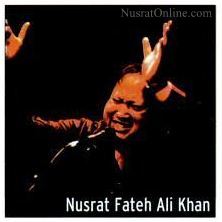 In the summer of 1985,Nusrat performed at the World Music Arts and Dance festival (WOMAD) in London, where he stood out as the most promising singer. After the success of that summer, he began to perform his music without regard to genre or tradition. His various experimentations, such as the use of scat-like singing improvisation, bought a fresh breeze into the traditional world of qawwali. This new openness led to the popularization of Sufi music across both geographical and musical boundaries. His concerts in Paris in 1985 and 1988 were received with great enthusiasm as his amazing vocal performances produced a craze for his music throughout Europe. His first visit to Japan took place in 1987, at the invitation of the Japan Foundation. His participation in seminars and his performances at the 5th Asian Traditional Performing Art Festival and subsequent concerts in Japan have earned him a steadily increasing number of fans in this country. He has also released several CDs in Japan, and performed in a number of successful large-scale concerts all over the world.
Ustad Nusrat Fateh Ali Khan’s accomplishments have contributed both to the succession and advancement of the qawwali tradition, and to the popularization of South Asia’s outstanding traditional music culture around the world. Moreover, he has brought innovation into the sphere of the qawwali by taking advantage of his artistic gifts and flexibility to transcend the rules imposed by tradition. These achievements, taken together, have had an immeasurable impact on cultural exchange between the East and the West; led to the enhancement of both cultures, and thus make Ustad Nusrat Fateh Ali Khan particularly worthy of receiving the Arts and Culture Prize of the Fukuoka Asian Cultural Prizes.
In the summer of 1985,Nusrat performed at the World Music Arts and Dance festival (WOMAD) in London, where he stood out as the most promising singer. After the success of that summer, he began to perform his music without regard to genre or tradition. His various experimentations, such as the use of scat-like singing improvisation, bought a fresh breeze into the traditional world of qawwali. This new openness led to the popularization of Sufi music across both geographical and musical boundaries. His concerts in Paris in 1985 and 1988 were received with great enthusiasm as his amazing vocal performances produced a craze for his music throughout Europe. His first visit to Japan took place in 1987, at the invitation of the Japan Foundation. His participation in seminars and his performances at the 5th Asian Traditional Performing Art Festival and subsequent concerts in Japan have earned him a steadily increasing number of fans in this country. He has also released several CDs in Japan, and performed in a number of successful large-scale concerts all over the world.
Ustad Nusrat Fateh Ali Khan’s accomplishments have contributed both to the succession and advancement of the qawwali tradition, and to the popularization of South Asia’s outstanding traditional music culture around the world. Moreover, he has brought innovation into the sphere of the qawwali by taking advantage of his artistic gifts and flexibility to transcend the rules imposed by tradition. These achievements, taken together, have had an immeasurable impact on cultural exchange between the East and the West; led to the enhancement of both cultures, and thus make Ustad Nusrat Fateh Ali Khan particularly worthy of receiving the Arts and Culture Prize of the Fukuoka Asian Cultural Prizes.
The Rise Of Nusrat Fateh Ali Khan Qawwal
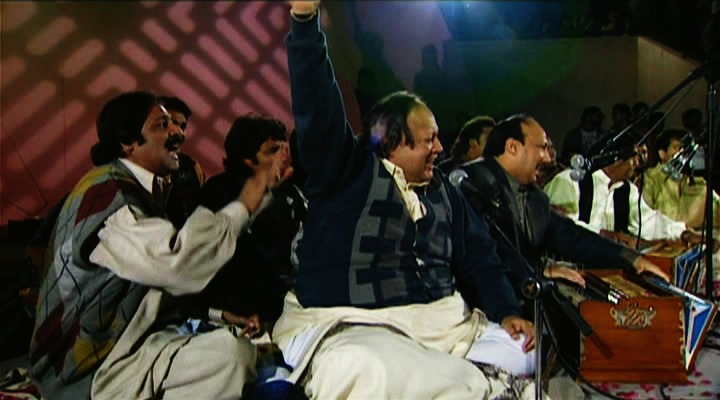
Nusrat continued to perform qawwali in religious rites–the original form in which qawwali is sung–at mausoleums of revered saints in Pakistan, which at the same time giving concerts at more conventional venues. In 1979, he was accorded the rare honor of performing inside one of the most prestigious shrines in the subcontinent, the shrine of Sufi Saint Moinuddin Chishti in Ajmer, India. The superb singing talent and musical skill of this great master of qawwali, along with his strong command of Urdu, Farsi (Persian), and his native language, Punjabi, have enabled him to sing the mystic poetry written in these languages with fluency and expressiveness. He is also famous for his unparalleled repertoire, which extends to several thousands of songs. In appreciation of his excellence, the Government of Pakistan awarded him the President’s Pride of Performance in Art in 1987.
[Read More]Nusrat Fateh Ali Khan's Early Life
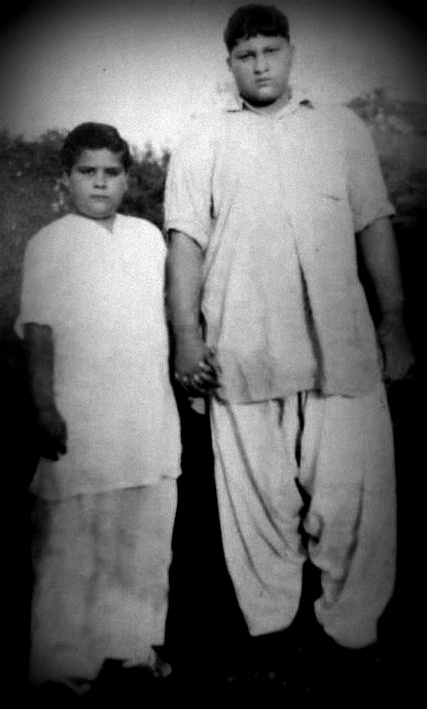
NFAK was nothing less than God’s blessing for his family , as he was born after four sisters… Her sisters were so happy that they were running out in streets shouting and writing on walls that ” God blessed them with a brother” , who knew that day it was a blessing not just for their family but for the entire world.[Read More]
Short Biography
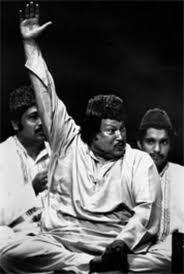
Nusrat Fateh Ali Khan was born in 1948 in Fajsalabad, in the Pakistani province of Punjab. He was a member of a family whose male descendants had specialized in the performance of religious music qawwali for over 600 years *. The music has developed on the basis of Sufism - the mystical trend of Islam. The essence of qawwali is prompting a religious trance enabling a direct contact with God.
[Read More]
Short Introduction
 “Nusrat - The Voice That Conquered more than Alexander’s Sword
There are great singers, and then there are those few voices that transcend time. The late Nusrat Fateh Ali Khan could not only transcend time, but also language and religion. There was magic when he opened his mouth, a sense of holy ecstasy that was exciting and emotional. It wasn’t uncommon even for Western listeners, who didn’t understand a word he was singing or follow his Sufi traditions, to be moved to tears upon hearing him.
[Read More]HIS GREATEST SONGS
Essential PATARI Playlist